
When Is Bone Grafting Needed Before Dental Implants?
Bone grafting may be needed before dental implants when the jaw does not have enough bone height, width, volume or the right shape to place an implant in a stable and restoratively useful position.
Not every patient with bone loss needs a separate graft. A small defect may sometimes be grafted at the same time as implant placement, while a larger deficiency may require grafting first and several months of healing before the implant can be placed.
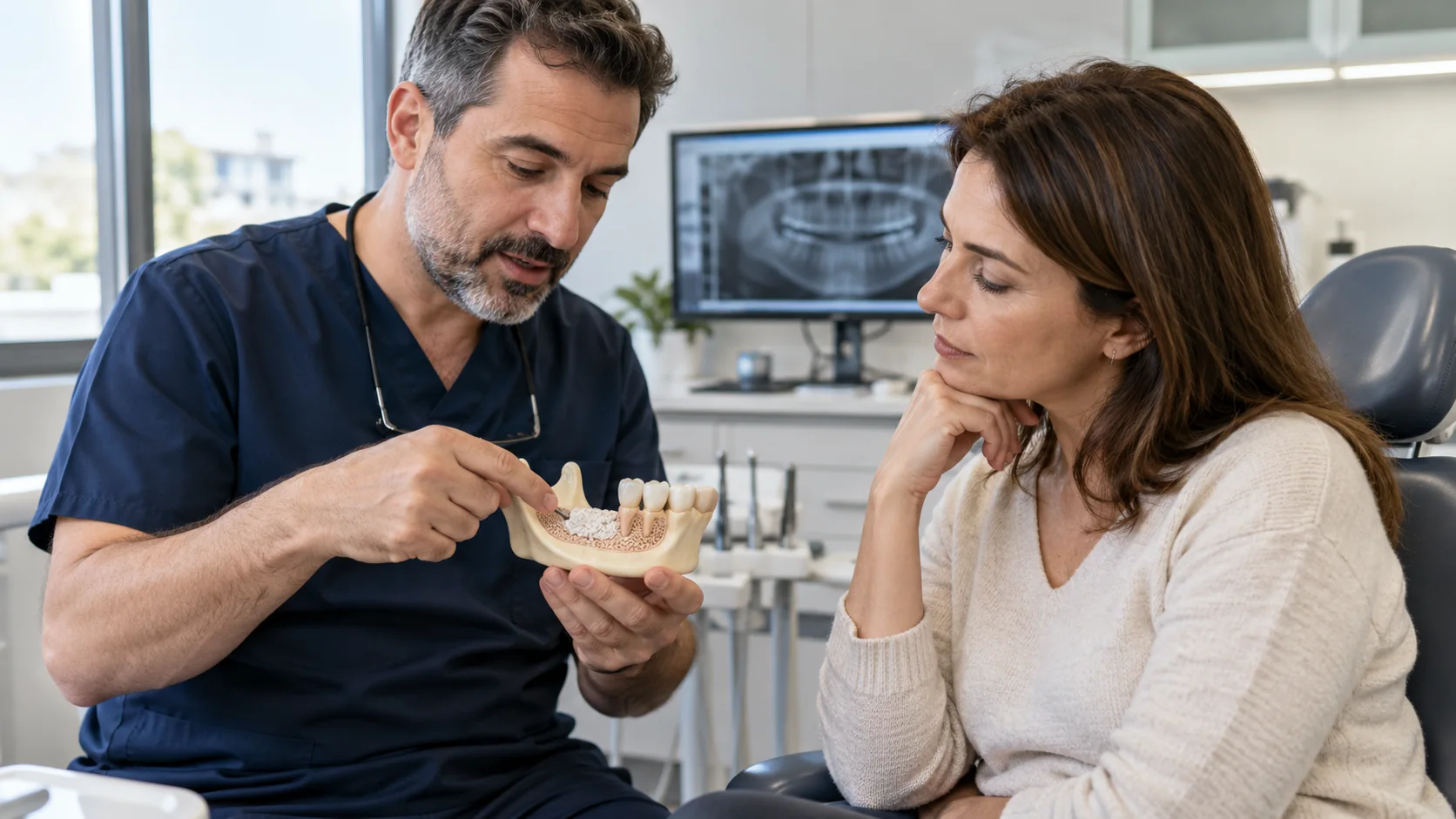
How do you know if you need a bone graft for dental implants?
Your implant dentist evaluates the jaw clinically and with dental imaging. A 3D scan can show whether there is enough bone around the planned implant position and whether important structures such as the sinus or lower-jaw nerve limit the available space.
-
✓
Enough bone An implant may be placed without grafting when adequate bone exists in a useful position.
-
+
Small bone defect A minor deficiency may sometimes be grafted at the same appointment as implant placement.
-
2
Larger bone deficiency More substantial reconstruction may need to heal before the implant is placed.
-
3D
CBCT planning Three-dimensional imaging helps the dentist assess bone dimensions and surrounding anatomy.
Why might there not be enough bone for an implant?
Jawbone can change considerably after teeth are lost. How much bone remains depends on the cause of tooth loss, how long the tooth has been missing and the anatomy of that area.
Long-term missing teeth
After a tooth is removed, the ridge that previously supported it can gradually reduce in width and height.
Periodontal disease
Advanced gum disease can destroy supporting bone around natural teeth before those teeth are eventually lost.
Previous infection
Large infections around a tooth root can leave a local bone defect after the infected tooth is removed.
Trauma
Dental injuries can damage both the tooth and the surrounding jawbone, reducing the bone available for future implant placement.
Extraction socket changes
Some extraction sites lose more bone than others during healing, particularly when the outer bone wall was already thin or damaged.
Natural anatomy
Some people naturally have a narrow ridge or limited bone near the sinus or the lower-jaw nerve even without severe disease.
How dentists decide whether bone grafting is necessary
The question is not simply “Do you have bone loss?” The important question is whether the remaining bone allows the implant to be positioned safely and correctly for the future crown or bridge.
What does the implant assessment look for?
The dentist considers both the quantity and quality of available bone and compares this with the size and position of the planned implant.
For complex cases, CBCT imaging provides a three-dimensional view of the jaw and helps identify structures that need to be avoided during surgery.
The final restorative position matters too. An implant should ideally support the future tooth in a position that allows a functional bite and reasonable cleaning access.
- Bone width around the planned implant.
- Available bone height.
- Shape and contour of the alveolar ridge.
- Position of the maxillary sinus in the upper back jaw.
- Position of the inferior alveolar nerve in the lower jaw.
- Condition of the gums and surrounding tissues.
- Number, diameter and length of implants being considered.
- Final crown, bridge or full-arch position.
When is a bone graft commonly needed before implants?
Bone augmentation can be used for different types of bone deficiency. The procedure chosen depends on where bone is missing and how much needs to be reconstructed.
The ridge is too narrow
An implant needs bone around its circumference. If the jaw ridge is too thin to accommodate the desired implant safely, horizontal ridge augmentation may be recommended.
The ridge is too low
Loss of vertical bone height can make implant placement difficult, particularly near important anatomical structures. More advanced augmentation may be required in selected cases.
An extraction left a significant defect
When infection, trauma or loss of the socket wall leaves inadequate support, grafting may rebuild the area before or at implant placement.
The upper back jaw has limited bone below the sinus
A sinus augmentation may be considered when there is not enough vertical bone between the mouth and the maxillary sinus for the planned implant.
Can the bone graft and dental implant be done at the same time?
Sometimes. The decision depends mainly on the size of the defect and whether the implant can still achieve enough primary stability in the existing bone.
Graft and implant together
A small amount of graft material may be added around an implant at the same appointment when the implant can already be positioned securely in the available native bone.
Guided bone regeneration is one example of an approach that can sometimes be performed together with implant placement.
Bone graft first
When there is not enough native bone to stabilize the implant or reconstruct the site predictably at the same time, the graft may need to be completed first.
The graft is then allowed to heal before implant placement.
How long before the implant?
Extensive grafting can add several months to treatment. Cambridge University Hospitals notes that more extensive grafting is typically performed at least four months before implant placement.
Healing time varies according to graft size, material, location and individual biology.
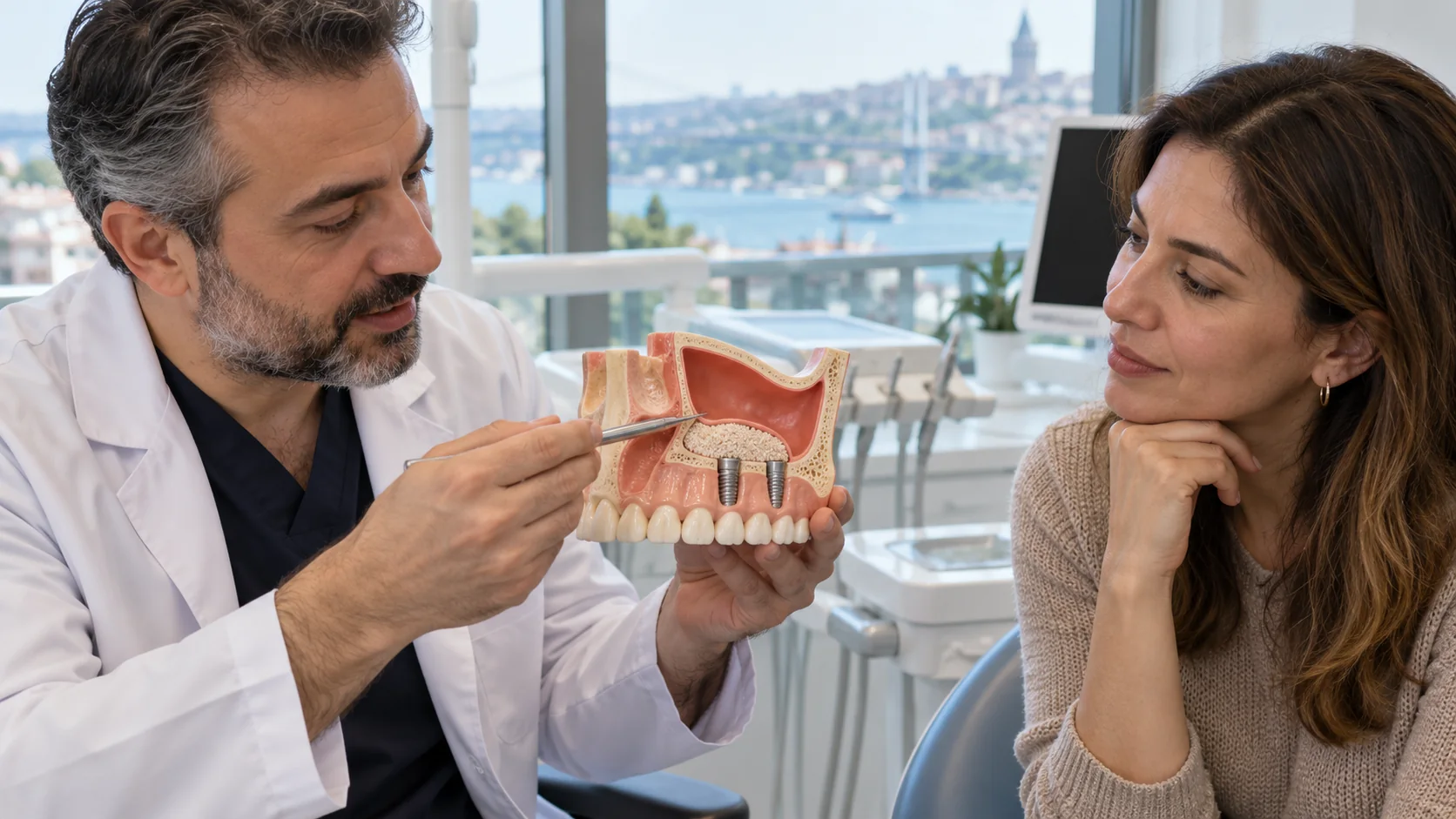
Is a sinus lift the same as a bone graft?
A sinus lift is a specific type of bone augmentation used in the upper back jaw. It creates additional bone height beneath the maxillary sinus so implants can be placed where the available vertical bone is limited.
- Location: upper premolar and molar region.
- Problem: insufficient bone height below the maxillary sinus.
- Procedure: the sinus membrane is carefully elevated and graft material is placed beneath it.
- Timing: the implant may sometimes be placed at the same appointment or later after graft healing.
- Decision: depends on the remaining native bone and whether implant stability can be achieved.
Read: What Is a Sinus Lift for Dental Implants? and Sinus Lift Turkey.
What types of bone grafting are used before implants?
The technique depends on the size and shape of the defect. Not every patient needs the same graft or the same amount of reconstruction.
Graft material and a protective membrane can be used to rebuild localized defects around an implant site.
Bone width or height can be increased when the existing ridge is inadequate for the planned implant.
Larger defects may require a block of bone or another more extensive augmentation technique before implants are placed.
Bone is added beneath the sinus in the upper posterior jaw when vertical bone height is insufficient.

Can dental implants be placed without a bone graft?
Sometimes. Implant treatment can occasionally be planned around the bone that remains, but avoiding grafting should never mean placing implants in a poor position simply to make treatment faster.
- Different implant position: useful areas of existing bone may sometimes be used instead.
- Angled implants: selected full-arch treatments may use angled posterior implants to avoid anatomical limitations.
- Short implants: specific cases may allow shorter implants where vertical bone is limited.
- Alternative prosthetic plan: fewer implants supporting a bridge or a different restoration may sometimes be appropriate.
- No implant: in some cases a conventional bridge or removable restoration may be more suitable than complex augmentation.
See Dental Implants Without Bone Graft and Can You Get Dental Implants with Bone Loss?.
How long does a bone graft need to heal before implants?
Healing time depends on the size and type of graft. Small augmentation completed at implant placement follows a different timeline from a large staged block graft.
For more extensive staged grafting, several months of healing may be required before implant placement. Some hospital protocols describe approximately four to six months before implants are placed after larger grafts.
Your own treatment schedule should therefore be based on the graft and clinical assessment rather than a fixed calendar date.
- 1. Graft placement: deficient bone is reconstructed.
- 2. Early soft-tissue healing: the gum closes over the surgical area.
- 3. Bone maturation: the graft becomes incorporated and new bone develops.
- 4. Reassessment: imaging and clinical examination determine whether the site is ready.
- 5. Implant placement: the implant is inserted once adequate stable bone is available.
- 6. Osseointegration: the implant then requires its own healing period before the final restoration.
Is bone grafting before dental implants always successful?
Bone augmentation is an established part of implant dentistry, but it is still a surgical procedure and cannot be guaranteed to succeed in every patient.
Graft infection
Like other oral surgical procedures, grafts can develop infection and may occasionally require additional treatment or removal.
Incomplete bone gain
The final amount of regenerated bone may be less than originally planned, which can require changes to the implant strategy.
Membrane or wound problems
Some augmentation techniques use membranes or barriers that can become exposed if the gum does not heal as expected.
Longer treatment
Staged grafting can add several months before implant placement and then the implant itself still needs time to integrate.
Smoking
Smoking can adversely affect oral healing and should be discussed before bone grafting or dental implant surgery.
Individual medical factors
Your medical history, medications and general healing ability need to be considered before elective grafting procedures.
Bone grafting before dental implant questions
Common questions about bone volume, graft timing, sinus lifts and whether implants can be placed without grafting.
How do I know if I need a bone graft before a dental implant?
Your dentist assesses the implant site clinically and with imaging. Bone grafting may be recommended when there is not enough suitable bone height, width or volume to position and stabilize the planned implant.
Can a dental implant be placed if there is bone loss?
Often, yes. Depending on the amount and location of bone loss, treatment may involve simultaneous grafting, staged bone augmentation, sinus augmentation, angled implants or another implant strategy.
Can a bone graft and implant be done at the same time?
Yes, in suitable cases. Small bone defects can sometimes be grafted during implant placement when enough existing bone remains to stabilize the implant. Larger defects may require grafting first.
How long after a bone graft can you get a dental implant?
Timing varies with the type and size of graft. Larger staged grafts commonly require several months of healing before implant placement, while small grafts may be performed simultaneously with the implant.
Why does bone shrink after losing a tooth?
The alveolar bone that supported the tooth remodels after extraction or tooth loss. Over time the ridge can become narrower and lower, although the amount of change differs between patients and sites.
Is a sinus lift a bone graft?
A sinus lift is a specific bone augmentation procedure in the upper back jaw. Graft material is placed beneath the elevated sinus membrane to increase bone height for implants.
Does every dental implant need a bone graft?
No. Patients who have sufficient healthy bone in an appropriate position can often receive dental implants without bone grafting.
Can All-on-4 avoid a bone graft?
All-on-4 can sometimes make strategic use of available bone and reduce the need for extensive grafting by using angled posterior implants. However, it does not guarantee graft-free treatment for every patient.
Is bone grafting painful?
The surgical area is normally numbed with local anaesthesia. Postoperative swelling, soreness and bruising can occur afterwards, and the amount depends on the extent of the grafting procedure.
Can a bone graft fail?
Yes. Bone grafting is generally successful when appropriately selected and performed, but infection, wound problems or inadequate bone formation can occur and occasionally require further treatment.
Not sure whether you need bone grafting before implants?
Bone grafting should be recommended because your anatomy requires it—not automatically because you are having implants. Send your recent dental X-ray or scan to discuss whether the available bone may support implant placement directly or whether augmentation should be considered.
- 1Review available bone from your X-ray or scan
- 2Check whether grafting is actually needed
- 3Compare staged vs simultaneous grafting
- 4Review sinus lift and graft-free options
This page provides general educational information and does not determine whether an individual patient needs grafting. References: Cambridge University Hospitals — Bone Grafting for Dental Implants, Leeds Teaching Hospitals — Dental Implants and American Academy of Periodontology — Dental Implant Procedures.